
Mooncake Store Deployment & Tuning Guide#
This guide covers minimal deployment, and operational tuning of Mooncake Store.
Architecture Overview#
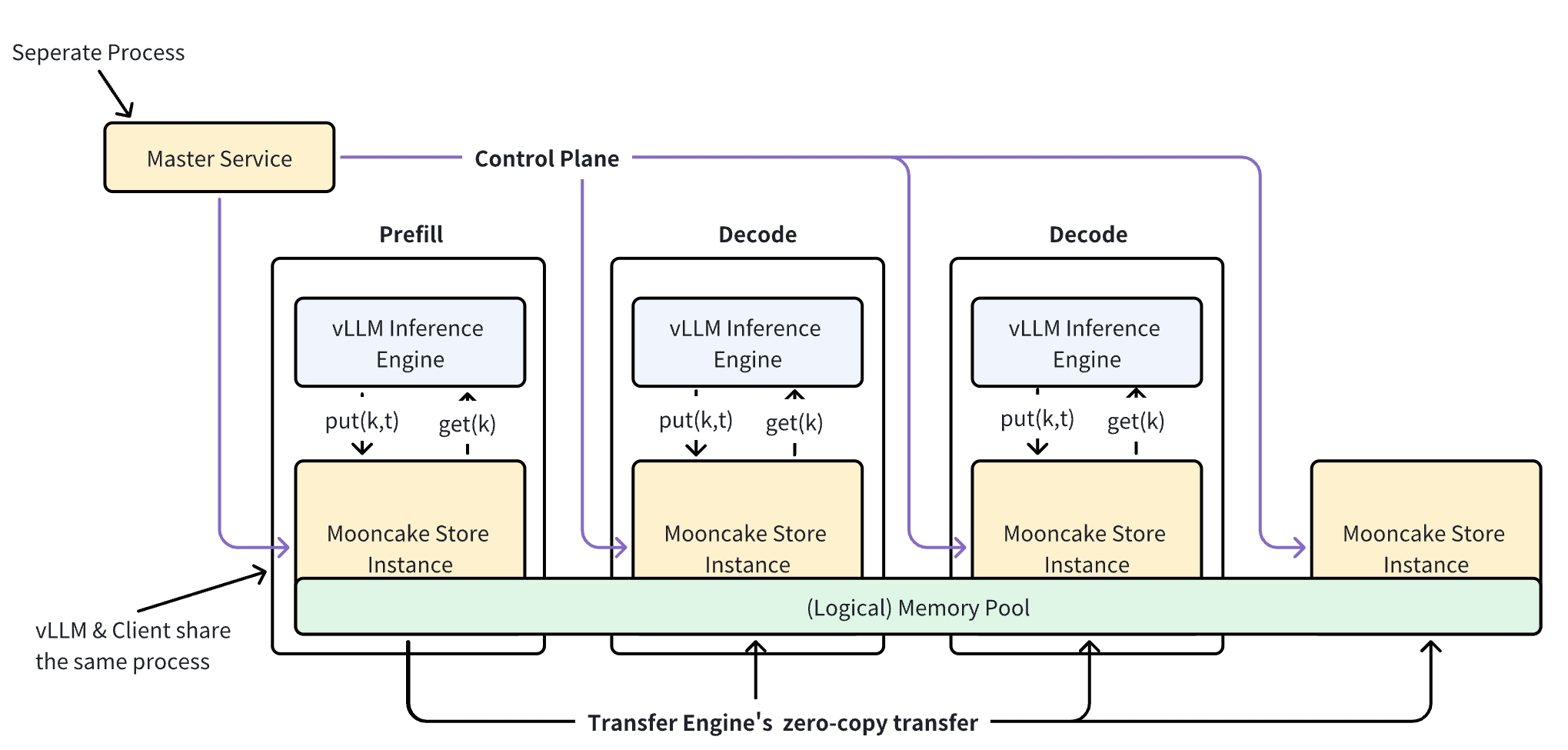
Master Service (mooncake_master): The central coordinator. It manages cluster membership, allocates object storage across client nodes, and enforces eviction/placement policies. Runs as a standalone process.
Client Node: Each node contributes DRAM (and optionally VRAM/SSD) to form the distributed cache pool. Clients communicate with the master over RPC for control operations (Put/Get/Remove), but transfer actual data directly between each other via the Transfer Engine — the master is never in the data path.
Metadata Service: A separate service (etcd, Redis, or HTTP) used by the Transfer Engine for peer discovery and configuration. The master’s embedded HTTP metadata server can replace an external etcd/Redis for simple deployments. We also provide a P2P handshake mechanism (P2PHANDSHAKE) that enables decentralized metadata management by storing metadata locally on each node, eliminating the need for a centralized service — this is the simplest metadata handshake method and the recommended starting point (see Quick Start).
For a detailed design discussion, see the Mooncake Store Design.
Quick Start#
Deploy a minimal single-node Mooncake Store in three steps.
1. Start the Metadata Service#
This quick start uses P2P handshake — the simplest option, with nothing to start: each node exchanges and stores Transfer Engine metadata locally during connection setup. You just pass the literal string P2PHANDSHAKE as the client’s metadata_server (step 3).
For large or long-lived clusters, use the master’s embedded HTTP metadata server or an external etcd/Redis instead — see Deployment Scenarios.
2. Start the Master Service#
With P2P handshake the master needs no metadata-server flags:
mooncake_master
On success the master logs a single line like:
Master service started on port 50051, max_threads=4, ...
The master’s default RPC port is 50051. (To embed an HTTP metadata server instead of using P2P, add --enable_http_metadata_server=true --http_metadata_server_port=8080.)
3. Start a Store Client#
A client contributes DRAM (and optionally SSD) to the cluster. The simplest way is to embed Mooncake in a Python process and call store.setup(...) with metadata_server="P2PHANDSHAKE":
from mooncake.store import MooncakeDistributedStore

store = MooncakeDistributedStore()
store.setup(
    local_hostname="localhost",
    metadata_server="P2PHANDSHAKE",           # decentralized; no metadata service
    global_segment_size=3200 * 1024 * 1024,   # DRAM contributed to the cluster
    local_buffer_size=512 * 1024 * 1024,      # Transfer Engine buffer
    protocol="tcp",
    rdma_devices="",                          # keyword is rdma_devices (not device_name)
    master_server_addr="127.0.0.1:50051",     # keyword is master_server_addr
)
There are three ways to run a client — programmatic (above), a standalone mooncake_store_service process (configured via MOONCAKE_*), and the mooncake_client real-client RPC process. See Reference: Client Configuration & Tuning for all three, with full parameter/env tables.
What just happened:
The client registered itself with the master via RPC.
The master allocated a 3.2 GB segment on this node and added it to the cluster’s memory pool.
The client is now ready to serve
Put/Get/Removerequests.
Run the Stress Benchmark#
Mooncake Store includes sample programs for validating C++ and Python integrations. The stress benchmark script can be used to verify a two-role prefill/decode setup.
Configure the script with command-line flags (run with --help for the full list):
--local-hostname: the local machine’s reachable IP address or hostname.--metadata-server: the Transfer Engine metadata service, e.g.P2PHANDSHAKE,http://127.0.0.1:8080/metadata, or an etcd address.--master-server: the Mooncake Store master address. UseIP:Portin default mode, oretcd://IP:Port;IP:Port;...;IP:Portin etcd-backed HA mode.--protocol: transport,tcp/rdma/cxl/ascend(defaults tordma).
Then start the roles:
python3 mooncake-store/tests/stress_cluster_benchmark.py --role prefill
python3 mooncake-store/tests/stress_cluster_benchmark.py --role decode
For RDMA, topology auto-discovery and NIC filters can be passed through environment variables:
MC_MS_AUTO_DISC=1 MC_MS_FILTERS="mlx5_1,mlx5_2" python3 mooncake-store/tests/stress_cluster_benchmark.py --role prefill
MC_MS_AUTO_DISC=1 MC_MS_FILTERS="mlx5_1,mlx5_2" python3 mooncake-store/tests/stress_cluster_benchmark.py --role decode
The absence of errors indicates successful data transfer.
Verify Installed Examples#
For a Python integration check, run mooncake-store/tests/distributed_object_store_provider.py after starting the metadata service and mooncake_master.
For a C++ integration check, run build/mooncake-store/tests/client_integration_test after building tests and starting the required services.
Verify#
# Health check — master metrics endpoint
curl -s http://localhost:9003/metrics/summary

# List registered clients
# (exposed through the store's Python API or RPC)
Deployment Scenarios#
Single-Node (TCP) — Development / Quick Evaluation#
The simplest deployment, as shown in Quick Start. A single mooncake_master orchestrates clients over TCP. Suitable for development, testing, and single-host evaluation.
mooncake_master \
  --enable_http_metadata_server=true \
  --http_metadata_server_host=0.0.0.0 \
  --http_metadata_server_port=8080
Limitation: the master is a single point of failure. If it crashes, cluster operations pause until it is restored.
High-Availability (etcd) — Production HA#
Runs a cluster of master instances coordinated through etcd. If the leader fails, the remaining instances elect a new leader automatically.
# Start each master instance with:
mooncake_master \
  --enable_ha=true \
  --ha_backend_type=etcd \
  --ha_backend_connstring="10.0.0.1:2379;10.0.0.2:2379;10.0.0.3:2379" \
  --enable_oplog=true \
  --rpc_address=10.0.0.1
Each instance must specify its own reachable --rpc_address. --etcd_endpoints is still accepted as a backward-compatible alias for the etcd HA backend connection string when --ha_backend_connstring is empty. The etcd cluster used for HA can be shared with or separate from the Transfer Engine’s metadata etcd.
Client addressing: to reach an HA cluster, clients must use the etcd:// master-address form (so they can discover the current leader) instead of a single IP:Port — set master_server_addr (Method A) / MOONCAKE_MASTER (Method B) / --master_server_address (Method C) to etcd://10.0.0.1:2379;10.0.0.2:2379;....
High-Availability (Redis) — Alternative HA Backend#
Same HA semantics but using Redis instead of etcd for leader election:
mooncake_master \
  --enable_ha=true \
  --ha_backend_type=redis \
  --ha_backend_connstring="redis://127.0.0.1:6379" \
  --rpc_address=10.0.0.1
Client addressing: clients reach a Redis-backed HA cluster with the redis://connstring master-address form (e.g. redis://127.0.0.1:6379) for master_server_addr / MOONCAKE_MASTER / --master_server_address, instead of a single IP:Port. Redis is used only for leader election here. OpLog replication currently requires ha_backend_type=etcd.
Snapshot & Restore — Backup / Disaster Recovery#
Caution
Metadata Snapshot And Restore is experimental feature.
Periodically persist master metadata to local disk or S3, enabling recovery from a recent snapshot after a crash.
export MOONCAKE_SNAPSHOT_LOCAL_PATH=/data/mooncake_snapshots

mooncake_master \
  --enable_snapshot=true \
  --snapshot_interval_seconds=300 \
  --snapshot_retention_count=5 \
  --snapshot_object_store_type=local \
  --enable_snapshot_restore=true
Tiered Storage with SSD Offload — Cost-Effective Capacity#
Extends the cache pool from DRAM to SSD while keeping normal reads and writes on the distributed memory path. With --enable_offload=true, completed memory writes are queued for asynchronous SSD persistence through the master control plane. Set --offload_on_evict=true to defer that SSD write until the memory eviction path selects an object for reclamation. When --promotion_on_hit=true, SSD-only objects can be promoted back to DRAM after repeated reads; admission is gated by --promotion_admission_threshold.
mooncake_master \
  --enable_offload=true \
  --offload_on_evict=true \
  --promotion_on_hit=true \
  --promotion_admission_threshold=2 \
  --enable_http_metadata_server=true \
  --http_metadata_server_port=8080
Do not set --root_fs_dir with --enable_offload=true. --root_fs_dir is a legacy parameter from an older persistence path and may cause issues on the SSD offload path. Configure each real client’s offload directory with MOONCAKE_OFFLOAD_FILE_STORAGE_PATH instead.
CXL-Aware Allocation — Memory Tiering#
When the host has CXL-attached memory, the master can preferentially allocate new objects on the CXL tier, reserving local DRAM for latency-sensitive operations.
mooncake_master \
  --enable_cxl=true \
  --cxl_path=/dev/dax0.0 \
  --cxl_size=17179869184 \
  --allocation_strategy=cxl
Container / Dynamic Network Interface#
When the master runs in a container with a dynamic IP, use --rpc_interface to resolve the RPC address from a stable interface name:
mooncake_master \
  --rpc_interface=eth0 \
  --enable_http_metadata_server=true \
  --http_metadata_server_host=0.0.0.0 \
  --http_metadata_server_port=8080
The master resolves the current IPv4 address of eth0 at startup and uses it as the advertised RPC address.
High Availability (HA)#
Mooncake Store supports a Primary-Standby HA model with batch-record OpLog replication. The active Primary serves traffic and writes ordered batches to etcd. Standby nodes poll the durable batch prefix and apply each entry in strict sequence order.
HA Architecture#
+------------------+     etcd batch records     +---------------+
| Primary          | --------------------------> | Standby       |
| OrderedOpLogWriter|     durable_prefix         | OpLogApplier  |
| MasterService    |                              | MetadataStore |
+------------------+                              +---------------+
       ^                                                 |
       |         Leadership Election                      |
       +---------------- etcd/redis/k8s ------------------+
HA Configuration#
HA leadership and metadata replication are configured separately:
The HA coordinator elects the active master. Configure it with
--enable_ha,--ha_backend_type,--ha_backend_connstring, and--cluster_id. Forha_backend_type=etcd, legacy--etcd_endpointsis used only when--ha_backend_connstringis empty.The optional batch-record OpLog persists metadata mutations so standby masters can catch up and later be promoted. Enable it explicitly with
--enable_oplog=true; it is disabled by default and requiresha_backend_type=etcdand a build withSTORE_USE_ETCD.The optional standby-generated batch OpLog snapshot path is enabled with
--enable_oplog_snapshot=truetogether with--enable_oplog=true. It uses the batch snapshot provider/coordinator and does not use the legacy catalog snapshot manager. Startup fails when the required etcd, cluster ID, object-store, or chunk configuration is invalid; a temporary upload failure leaves OpLog apply running for a later attempt.--enable_oplog: Enable the primary OpLog writer and standby reader. Defaults tofalse.--enable_oplog_snapshot: Enable standby-generated snapshots for batch OpLog recovery. Defaults tofalse; requiresenable_oplog=true, HA with etcd, a valid snapshot object store, and a persistentMOONCAKE_SNAPSHOT_LOCAL_PATHwhen usinglocal.--snapshot_chunk_object_count: Maximum objects written to one batch OpLog snapshot chunk. Defaults to1000000; must be greater than zero whenenable_oplog_snapshot=true.--oplog_poll_interval_ms: Base polling and retry delay for the batch standby, in milliseconds.--oplog_batch_max_entries: Maximum number of entries admitted to an ordered batch. Defaults to1024.--batch_oplog_retry_timeout_sec: Maximum consecutive retryable batch-standby failure window in seconds (default180).
For legacy catalog snapshot-based standby bootstrap, configure:
--enable_snapshot_restore(bool, defaultfalse): Enable standby to bootstrap from the latest snapshot at startup.--snapshot_object_store_type(str): Snapshot object store type:localors3.--snapshot_catalog_store_type(str): Snapshot catalog store type:embedded(default) orredis.
For the new batch OpLog snapshot path, configure:
enable_ha: true
ha_backend_type: "etcd"
enable_oplog: true
enable_oplog_snapshot: true
snapshot_chunk_object_count: 1000000
snapshot_interval_seconds: 600
snapshot_object_store_type: "local"
The new path stores immutable artifacts below a cluster-specific batch OpLog
snapshot root. It restores latest, then fallback, then a proven complete
OpLog and replays only the suffix after the snapshot cursor. It remains
non-serving if recovery cannot prove a complete state.
Standby Bootstrap#
When a Standby starts, it follows this sequence:
Snapshot Bootstrap (if
enable_snapshot_restore=truefor legacy catalog snapshots, orenable_oplog_snapshot=truefor batch OpLog snapshots):Legacy mode loads the latest snapshot from the configured catalog and object store. Batch OpLog mode loads the latest/fallback descriptor and manifest directly from the batch snapshot control keys.
Rebuild object metadata and segment state from the snapshot baseline.
OpLog Catch-up:
Start from the snapshot’s
last_included_seq(or from 1 if no snapshot).Poll
durable_prefix, read batch records up to that boundary, and apply entries in strict sequence order.
Supported OpLog entry types:
PUT_END: Object write completionREMOVE: Object removalPUT_REVOKE: Object revocationSEGMENT_MOUNT: Segment mount eventSEGMENT_UNMOUNT: Segment unmount eventSEGMENT_UPDATE: Segment update event
Promotion and Failover#
When the Primary fails, the Standby is promoted through the following steps:
Leadership Lease: The supervisor must acquire and retain the leadership lease before promotion begins.
Final Prefix Read and Catch-up: The Standby stops its polling loop, reads
durable_prefixagain, and applies all durable batches. A missing prefix is accepted only when the local applied sequence is zero; otherwise promotion fails closed.Export Context: The Standby exports its current state as a
PromotionContext, including:applied_seq_id: The latest applied OpLog sequence ID.objects: All object metadata from the in-memory store.segments: All segment registry entries.
State Restoration: The new Primary restores and validates the complete
PromotionContext, populating metadata shards and the segment manager. A context with zero objects and segments still passes through restoration so that unsupported recovery modes cannot bypass validation.Serving Gate: The supervisor revalidates leadership and exposes the RPC service only after restoration succeeds. Promotion, restoration, or leadership validation failure leaves
service_ready=false, keeps data endpoints unavailable, and releases leadership. Failure to release leadership does not make the candidate serviceable.Invalid Endpoint Filtering: During restoration, any replica endpoints that correspond to segments no longer in the registry are automatically filtered out from
GetReplicaListresults.
This fail-closed behavior is intentional. Older versions could log a restoration error and continue serving from empty or partially restored metadata. That behavior was a correctness bug, not a supported availability fallback: the serving state could disagree with the durable OpLog and poison later recovery attempts. Mooncake does not automatically discard snapshots, OpLog records, or metadata after a recovery error.
Example: HA Deployment with etcd#
Primary configuration (primary.yaml):
enable_ha: true
ha_backend_type: "etcd"
ha_backend_connstring: "etcd-1:2379;etcd-2:2379;etcd-3:2379"
cluster_id: "mooncake_cluster"
enable_oplog: true
oplog_poll_interval_ms: 1000
oplog_batch_max_entries: 1024
enable_oplog_snapshot: true
snapshot_chunk_object_count: 1000000
snapshot_interval_seconds: 600
snapshot_object_store_type: "local"
rpc_port: 50051
Standby configuration (standby.yaml):
enable_ha: true
ha_backend_type: "etcd"
ha_backend_connstring: "etcd-1:2379;etcd-2:2379;etcd-3:2379"
cluster_id: "mooncake_cluster"
enable_oplog: true
oplog_poll_interval_ms: 1000
oplog_batch_max_entries: 1024
enable_oplog_snapshot: true
snapshot_chunk_object_count: 1000000
snapshot_interval_seconds: 600
snapshot_object_store_type: "local"
rpc_port: 50052
Environment variable for local snapshot storage:
export MOONCAKE_SNAPSHOT_LOCAL_PATH=/data/mooncake_snapshots
Start the cluster:
# Start Primary
mooncake_master --config_path=primary.yaml

# Start Standby
mooncake_master --config_path=standby.yaml
Recovery from Unusable HA State#
First repair temporary backend, configuration, or snapshot-access failures and restart the affected Standby. If the recovery history is confirmed unusable and losing all cached metadata is acceptable, start a new empty cluster explicitly:
Stop every Primary and Standby process that uses the old
cluster_id.Confirm that losing the old cache metadata and snapshots is acceptable.
Change every node to a new, previously unused
cluster_id.Start the new cluster and allow applications to repopulate the cache.
Keep the old namespace for diagnosis, then remove it separately after confirming that no old process can reconnect.
Using a new cluster_id isolates the new cluster from the old OpLog, durable prefix, producer view, and snapshot namespace. Do not delete individual recovery keys or reuse the old cluster_id while any old process may still run. There is no automatic reset-on-restore-failure option.
Resetting a Legacy OpLog Namespace#
The batch-only implementation does not migrate or read older per-entry OpLog data. Reusing a namespace that contains legacy latest, numeric entry, or snapshot sidecar keys is rejected.
Reset is destructive:
Stop every Primary and Standby process that uses the cluster ID.
Confirm that loss of the old metadata and snapshots is acceptable.
Delete the complete
/oplog/{cluster_id}namespace directly with the operator’s etcd tooling.Start the cluster with empty state and batch-record OpLog enabled.
Do not delete individual compatibility keys while any process is running, and do not retain an old snapshot baseline with a nonzero sequence after deleting durable_prefix.
Metrics Endpoints#
The master exposes Prometheus-style metrics on --metrics_port:
# Prometheus format
curl -s http://<master_host>:9003/metrics

# Human-readable summary
curl -s http://<master_host>:9003/metrics/summary
When tenant quota is enabled, /metrics also includes per-tenant quota gauges and quota counters:
mooncake_tenant_quota_requested_bytes{tenant_id}mooncake_tenant_quota_effective_bytes{tenant_id}mooncake_tenant_quota_charged_bytes{tenant_id}mooncake_tenant_quota_admission_closed{tenant_id}mooncake_tenant_quota_over_quota{tenant_id}mooncake_tenant_quota_explicit_policy{tenant_id}mooncake_tenant_quota_reject_total{tenant_id,reason}mooncake_tenant_evict_bytes_total{tenant_id}mooncake_tenant_quota_allocatable_capacity_bytesmooncake_tenant_quota_requested_bytes_summooncake_tenant_quota_effective_bytes_sum
Tenant Quota Management#
Quick Tips#
Scale
--rpc_thread_numwith available CPU cores and workload.Start with default eviction settings; adjust
--eviction_high_watermark_ratioand--eviction_ratiobased on memory pressure and object churn.Use
/metrics/summaryduring bring-up; integrate/metricswith Prometheus/Grafana for production.For detailed SSD offload configuration (storage backends, eviction policies, io_uring), see the SSD Offload guide.
For NVMe-oF SSD pool configuration see the NVMe-oF SSD Pool Deployment Guide
For the experimental HF3FS USRBIO adapter used by descriptor-based DFS replicas, see the HF3FS USRBIO adapter guide.
For detailed monitoring and observation see Observability
Reference: Master Startup Flags#
RPC#
Flag |
Default |
Description |
|---|---|---|
|
|
RPC listen port. The literal default is |
|
|
RPC worker threads. The literal default is |
|
|
RPC bind address |
|
empty |
Network interface to resolve RPC address at startup (overrides |
|
|
Idle connection timeout; |
|
|
Enable TCP_NODELAY |
Logging#
The master uses glog. When --log_dir is set, all severities are merged into a single journal file in that directory (mooncake_master.INFO.<date>-<time>.<pid>), reachable through the stable mooncake_master.INFO symlink.
glog’s standard flags (--log_dir, --max_log_size, --logtostderr, …) control the rest.
Metrics#
Flag |
Default |
Description |
|---|---|---|
|
|
Periodically log master metrics |
|
|
HTTP port for |
KV Cache Event Publisher#
The master can publish KV cache lifecycle events over a ZMQ PUB socket for
cache-aware indexers such as Mooncake Conductor. This feature is compiled out
by default. Install libzmq3-dev and configure Mooncake Store with
-DENABLE_KV_EVENTS=ON before enabling it at runtime.
Both --kv_events_bind_endpoint and --kv_events_backend_id are required when
the publisher is enabled. If either value is empty, or the ZMQ socket cannot
bind, the master logs an error and continues with event publishing disabled.
mooncake_master \
  --enable_kv_events=true \
  --kv_events_bind_endpoint=tcp://0.0.0.0:5557 \
  --kv_events_backend_id=store-node-1
Register an address reachable by the indexer, rather than the wildcard bind
address, through the indexer’s POST /register endpoint. For the event format,
registration fields, and object-key behavior, see the Mooncake Store master publisher reference.
Flag |
Default |
Description |
|---|---|---|
|
|
Enable the ZMQ KV cache event publisher; requires a build with |
|
empty |
ZMQ PUB bind endpoint, for example |
|
empty |
Cache-owner identity emitted as |
|
|
Include vLLM/SGLang-compatible aliases such as |
|
|
Emit the raw Mooncake |
|
|
Maximum pending events; the publisher drops the oldest event when the queue is full and reserves its sequence number so the loss stays visible. Set to |
One master publisher serves one fixed model and parallel context, so the
remaining flags below are emitted verbatim in every event envelope. Empty
strings and --kv_events_block_size=0 are encoded as nil.
Flag |
Default |
Description |
|---|---|---|
|
empty |
Emitted as |
|
empty |
Emitted as |
|
empty |
Emitted as |
|
|
Emitted as |
|
|
Emitted as |
|
|
Accepted for configuration compatibility but not emitted. Every event carries the tenant of the Store operation that produced it |
HTTP Metadata Server (Embedded)#
Flag |
Default |
Description |
|---|---|---|
|
|
Enable embedded HTTP metadata server |
|
|
Metadata bind host |
|
|
Metadata TCP port |
|
|
Delete a client’s stale HTTP metadata ( |
Stale Metadata Cleanup on Client Timeout#
When a client crashes or is force-killed (kill -9, OOM, node failure), it cannot
run its normal cleanup, leaving stale entries on the HTTP metadata server
(mooncake/[<cluster>/]ram/<segment> and mooncake/[<cluster>/]rpc_meta/<segment>).
The HTTP metadata server has no heartbeat of its own, so these entries linger and
can mislead nodes that later connect or restart with different RDMA parameters.
With --enable_metadata_cleanup_on_timeout=true, the Master Service reuses its
existing client-heartbeat monitor: when a client’s --client_ttl expires, in
addition to unmounting the segment it also removes that client’s ram/ and
rpc_meta/ keys from the HTTP metadata server. It supports both deployment
topologies:
Co-located (
--enable_http_metadata_server=true): the master removes the keys via a direct in-process call (no network overhead).Separately deployed HTTP metadata server: the master derives the metadata server address from the cluster’s existing configuration and removes the keys via HTTP
DELETE. The address is read, in priority order, from:the
MOONCAKE_TE_META_DATA_SERVERenvironment variable (the same Transfer Engine metadata connection string the clients use, e.g.http://host:8080/metadata), thenthe
metadata_serverfield of the JSON file pointed to byMOONCAKE_CONFIG_PATH.
Notes:
Only
http(s)metadata servers are supported;etcd/redis/P2PHANDSHAKEbackends are not cleaned up (a warning is logged and cleanup stays disabled).The feature is opt-in and best-effort: if no co-located server is enabled and no HTTP metadata address can be derived, the master logs a warning and disables cleanup. Remote
DELETEfailures are logged but never block the client-monitor thread or the main process.Respects
MC_METADATA_CLUSTER_IDfor custom key prefixes (matching the Transfer Engine).
# Co-located metadata server
mooncake_master \
  --enable_http_metadata_server=true \
  --enable_metadata_cleanup_on_timeout=true \
  --client_ttl=10

# Separately-deployed HTTP metadata server (address derived from the env var)
export MOONCAKE_TE_META_DATA_SERVER=http://metadata-host:8080/metadata
mooncake_master \
  --enable_metadata_cleanup_on_timeout=true \
  --client_ttl=10
Memory Allocator#
Flag |
Default |
Description |
|---|---|---|
|
|
Memory allocator: |
Allocation Strategy#
Flag |
Default |
Description |
|---|---|---|
|
|
Allocation strategy: |
PutStart Timeouts#
Flag |
Default |
Description |
|---|---|---|
|
|
Seconds before an uncompleted |
|
|
Seconds before |
Eviction & TTLs#
Flag |
Default |
Description |
|---|---|---|
|
|
Lease TTL for KV objects. Supports |
|
|
Soft pin TTL (30 min) |
|
|
Maximum request-level soft pin TTL (24 h) |
|
|
Allow evicting soft-pinned objects |
|
|
Fraction evicted at high watermark |
|
|
Usage ratio triggering eviction |
|
|
Seconds before a silent client is considered disconnected |
Tenant Quota#
Flag |
Default |
Description |
|---|---|---|
|
|
Enable strict tenant registration and per-tenant memory quota admission |
|
|
Tenant quota policy connector type: |
|
empty |
Connector URI; for |
|
|
Usage ratio of a tenant’s own effective quota that triggers background eviction for that tenant; |
High Availability#
Master Node High Availability
Flag |
Default |
Description |
|---|---|---|
|
|
Enable HA mode |
|
|
HA backend: |
|
empty |
HA backend connection string |
|
empty |
Backward-compatible etcd HA endpoints, used only for |
|
|
Cluster ID for HA persistence |
|
|
Enable the primary OpLog writer and standby reader; currently requires |
|
|
Enable standby-generated batch OpLog snapshots; requires batch OpLog, HA/etcd, valid object-store configuration, and persistent local snapshot storage when applicable |
|
|
Maximum objects per batch OpLog snapshot chunk; must be positive when the new snapshot path is enabled |
|
|
Base polling and retry delay for the batch standby, in milliseconds |
|
|
Maximum number of entries admitted to an ordered batch |
|
|
Maximum consecutive retryable batch-standby failure window in seconds |
Caution
Metadata Snapshot And Restore is experimental feature.
Metadata Snapshot And Restore
Flag |
Default |
Description |
|---|---|---|
|
|
Enable periodic metadata snapshot |
|
|
Interval between snapshots |
|
|
Timeout per snapshot child process |
|
|
Number of recent snapshots retained |
|
required |
Object store: |
|
empty |
Catalog store: |
|
empty |
Catalog store connection string (required for |
|
empty |
Optional local backup directory |
|
|
Restore from latest snapshot at startup |
Environment variable: MOONCAKE_SNAPSHOT_LOCAL_PATH (required when --snapshot_object_store_type=local) — persistent directory for local snapshots.
Warning
The snapshot storage path is a managed directory exclusively controlled by Mooncake. Old snapshots exceeding --snapshot_retention_count are automatically deleted. Use a dedicated directory to avoid data loss.
Task Manager#
Flag |
Default |
Description |
|---|---|---|
|
|
Max finished tasks kept in memory |
|
|
Max queued pending tasks |
|
|
Max simultaneously processing tasks |
|
|
Timeout for pending tasks ( |
|
|
Timeout for processing tasks ( |
|
|
Max retries for failed tasks ( |
Offload / Tiered Storage#
Flags for controlling data movement between DRAM and SSD.
Flag |
Default |
Description |
|---|---|---|
|
|
Enable offload from DRAM to SSD |
|
|
Defer offload to eviction time rather than at |
|
|
Force-evict objects exceeding capacity without offload |
|
|
Max number of objects allowed in the offloading queue per local disk segment. Increase to allow more objects to be offloaded to SSD before force-eviction kicks in |
|
|
Per-cycle offload cap as a fraction of |
|
|
Promote SSD-resident keys to DRAM on read hit |
|
|
Min CountMinSketch count to allow promotion ( |
|
|
Max promotion tasks handed to a single client per heartbeat. Each task is a synchronous SSD-read + RDMA-write on the client; serializing them avoids blocking past the client-liveness window |
|
|
Max in-flight promotion tasks |
|
|
Storage quota in bytes |
|
|
Enable disk eviction |
Start with --enable_offload=true for eager asynchronous SSD persistence after Put completion. Add --offload_on_evict=true when you want SSD writes to happen only when memory pressure selects an object for eviction. Add --promotion_on_hit=true to allow hot SSD-only data to be promoted back to DRAM, and tune --promotion_admission_threshold to control how many observed reads are required before promotion is queued.
For SSD offload, configure the disk path on each real client with MOONCAKE_OFFLOAD_FILE_STORAGE_PATH; the master tracks these objects as LOCAL_DISK replicas. Do not use the legacy --root_fs_dir parameter with --enable_offload=true.
When --offload_on_evict=true is active, each BatchEvict cycle can queue at most offloading_queue_limit * offload_cap_ratio objects for SSD offload (default: 50000 * 0.5 = 25000); objects exceeding this cap fall back to force-evict (discard) if --offload_force_evict=true, otherwise they remain in memory. For SSD-heavy workloads where NVMe bandwidth is underutilized while the KV-cache hit rate suffers, raise both --offloading_queue_limit and --offload_cap_ratio so more objects per cycle are actually persisted to SSD instead of discarded. Example: --offloading_queue_limit=500000 --offload_cap_ratio=0.8 yields a per-cycle cap of 400000 (vs the default 25000).
CXL Memory#
Flag |
Default |
Description |
|---|---|---|
|
|
Enable CXL memory support |
|
|
DAX device path for CXL memory |
|
|
CXL memory size in bytes |
When --allocation_strategy=cxl is set alongside --enable_cxl=true, the master preferentially allocates new objects on CXL memory.
Descriptor-based DFS Storage#
Warning
Work in progress. Descriptor-based DFS is intended for development and evaluation only. It is not production-ready and is not covered by Mooncake Store’s general fault-tolerance, HA continuity, durability, or multi-tenant guarantees.
Mooncake Store can place an additional replica in a shared distributed filesystem. The master allocates aligned ranges in pre-created shard files and publishes a descriptor containing the shard, offset, and object size. Clients use that descriptor to access the same files through either regular POSIX I/O or the HF3FS USRBIO adapter.
DFS replicas are separate from LOCAL_DISK SSD-offload replicas. They do not
use the legacy --root_fs_dir persistence path or the master’s asynchronous
offload task queue.
Note
DFS allocator state is not yet restored after a master restart or HA leader failover. Do not enable descriptor-based DFS in a deployment that requires master recovery, HA continuity, or multiple tenants. See the complete list of limitations below.
Master configuration#
Enable the DFS allocator in the master process and select a shared root and shard layout. For example, to use HF3FS:
export MOONCAKE_ENABLE_DFS=1
export MOONCAKE_DFS_ROOT_DIR=/mnt/3fs/mooncake
export MOONCAKE_DFS_FS_ADAPTER=hf3fs
export MOONCAKE_DFS_SHARD_COUNT=64
export MOONCAKE_DFS_SHARD_CAPACITY=4294967296
export MOONCAKE_DFS_ALIGNMENT=4096
export MOONCAKE_DFS_SINGLE_TENANT=true

mooncake_master [other master arguments]
At startup, the master creates MOONCAKE_DFS_SHARD_COUNT shard files and
preallocates each file to MOONCAKE_DFS_SHARD_CAPACITY. The example therefore
configures 256 GiB of total logical shard capacity (64 * 4 GiB). Ensure the
shared filesystem has sufficient capacity; whether all backing space is
reserved immediately depends on the selected filesystem adapter.
The hf3fs adapter requires Mooncake to be built with USE_3FS=ON. Use
MOONCAKE_DFS_FS_ADAPTER=posix for development and integration testing on a
regular shared filesystem.
Client configuration#
Every client that may read or write a DFS replica must initialize
FileStorage and select the distributed backend. Use an absolute DFS root path;
the root string, shard count, shard capacity, and alignment must match the
master configuration. Select an adapter that can access the same underlying
shared files; the examples use the same adapter in every process.
export MOONCAKE_OFFLOAD_ENABLED=true
export MOONCAKE_OFFLOAD_STORAGE_BACKEND_DESCRIPTOR=distributed_storage_backend
export MOONCAKE_OFFLOAD_FILE_STORAGE_PATH=/data/file_storage
export MOONCAKE_MASTER=127.0.0.1:50051
export MOONCAKE_DFS_ROOT_DIR=/mnt/3fs/mooncake
export MOONCAKE_DFS_FS_ADAPTER=hf3fs
export MOONCAKE_DFS_SHARD_COUNT=64
export MOONCAKE_DFS_SHARD_CAPACITY=4294967296
export MOONCAKE_DFS_ALIGNMENT=4096
export MOONCAKE_DFS_SINGLE_TENANT=true

python -m mooncake.mooncake_store_service
For a programmatic Python client, pass enable_ssd_offload=True to setup()
instead of MOONCAKE_OFFLOAD_ENABLED. Programmatic setup still reads the
backend-specific MOONCAKE_OFFLOAD_STORAGE_BACKEND_DESCRIPTOR and
MOONCAKE_DFS_* variables shown above; only the launcher-level setup fields are
supplied as Python arguments. The
MOONCAKE_OFFLOAD_FILE_STORAGE_PATH directory must already exist and be an
absolute, writable, non-symlink directory. DFS shard data is stored under
MOONCAKE_DFS_ROOT_DIR; the FileStorage path is still required for client
initialization because the shared FileStorageConfig validates it even when
the selected backend stores data in the DFS root.
Native C++ clients must initialize a DistributedStorageBackend with the same
DFS layout and attach it to the client with SetDfsStorageBackend() before
issuing DFS reads or writes. Reads and writes use the DFS descriptor carried by
the current query or start-operation response; no client-side descriptor cache
is required.
DFS configuration reference#
Variable |
Scope |
Default |
Description |
|---|---|---|---|
|
Master |
|
Enable master-side DFS allocation. |
|
Master and clients |
|
Absolute shared shard root; use the same path string in every process. Falls back to |
|
Master and clients |
|
Filesystem adapter: |
|
Master and clients |
|
Initial shard count. The master also discovers existing contiguous shard files at startup; running clients open added shards on demand. |
|
Master and clients |
|
Logical file capacity of each shard in bytes. Each object is allocated wholly within one shard. |
|
Master and clients |
|
Allocation alignment in bytes; must be a power of two and divide the shard capacity. |
|
Master and clients |
|
Currently must remain |
|
Master |
|
Enable DFS allocator eviction. |
|
Master |
|
Usage ratio that triggers eviction. |
|
Master |
|
Usage ratio targeted by an eviction cycle. |
|
Master |
|
Delay before a freed shard range may be reused. |
|
Master |
|
Eviction check interval in seconds. |
Growing DFS capacity online#
The default shard allocator supports adding shard files while the master and clients remain running. Use the master’s existing HTTP admin listener:
curl http://127.0.0.1:9003/api/v1/dfs/shard_count
curl -X PUT http://127.0.0.1:9003/api/v1/dfs/shard_count \
  -H 'Content-Type: application/json' -d '{"shard_count": 128}'
Both requests return the current count, for example
{"success":true,"shard_count":128}. A PUT sets the desired total count,
not the number to add. Repeating the current count succeeds without changing
anything; shrinking, non-integer values, and non-positive counts return HTTP
400. DFS-disabled masters and concurrent expansion requests return HTTP 409;
unavailable or standby services return HTTP 503. Filesystem preparation runs
off the HTTP I/O threads, so health checks and other administration remain
available while an expansion is pending.
Upgrade the master and every DFS client to a version supporting online shard
expansion before increasing capacity. An already running upgraded client can
open a new shard from its descriptor even when its initial
MOONCAKE_DFS_SHARD_COUNT is smaller. Older binaries reject those descriptors.
Every process must still use the same shared root, adapter, shard capacity, and
alignment. Provision sufficient backing filesystem space before expanding;
changing the root or per-shard capacity online is unsupported.
Only one active master may manage a DFS root. Do not create, rename, truncate, or remove its shard files outside that master. Clients do not create shard files during initialization; they open them only from published descriptors.
The allocator prepares new files and allocation state before publishing the expanded shard set. Existing paths and allocated ranges remain unchanged, including when the shard index gains another decimal digit. Allocation, reads, writes, deferred frees, and eviction continue to use ready shards. A failed expansion leaves the published shard count unchanged.
On startup, the master discovers the contiguous existing shard layout and uses at least the configured count. Duplicate indices, missing intermediate shards, and unexpected file sizes are rejected rather than silently changing the layout. This preserves capacity, not cached key metadata or allocation ownership: DFS allocator recovery, snapshots, and HA remain subject to the limitations below. Do not treat online expansion as a data durability guarantee.
Requesting and accessing DFS replicas#
Callers request DFS placement through ReplicateConfig:
from mooncake.store import ReplicateConfig

config = ReplicateConfig()
config.replica_num = 1
config.dfs_replica_num = 1
store.put("key", b"value", config)
dfs_replica_num may currently be 0 or 1. A DFS replica must be requested
with at least one memory replica (replica_num >= 1), so DFS-only placement is
not supported.
Allocation first tries the key’s hash-selected DFS shard, then tries other
ready shards if that shard has no suitable extent. This lets new shards accept
writes even when older shards are full. NO_AVAILABLE_HANDLE means no ready
shard could satisfy the allocation. A DFS object is never striped across shards.
The selected shard must have room for the object rounded
up to MOONCAKE_DFS_ALIGNMENT, plus up to one alignment unit of allocator
padding (MOONCAKE_DFS_ALIGNMENT - 1 bytes); usable object capacity is
therefore lower than the shard file’s
logical size.
For Put, BatchPut, Upsert, and BatchUpsert, the client writes requested
memory and NoF replicas, stages device buffers to host memory when necessary,
and then performs positional DFS writes. A successful request means the
requested DFS WriteAt operations completed. It does not imply that an
additional fsync completed. Batch operations isolate failures by key; a
failed key is revoked without downgrading successful keys.
For a same-size Upsert, if either the existing object or the new request has
a DFS replica, the requested memory, NoF, and DFS replica counts must match the
existing topology. A different-size update releases the old placement and
allocates a new topology.
On reads, the master returns the readable replica list through the normal query path, and the client selects the first complete replica. If it selects DFS, any client configured with the same DFS root and shard layout can issue positional reads for that descriptor.
Current limitations#
Only the
defaulttenant is supported.dfs_replica_nummust be0or1, andreplica_num >= 1is required when it is enabled.C and Rust clients cannot currently request or access descriptor-based DFS: their replication configuration does not expose
dfs_replica_num, and their setup API cannot initialize the distributedFileStoragebackend. Use the native C++ or Python/RealClient API.A DFS object must fit in a single shard after alignment and allocator padding; objects are not striped across shards.
DFS allocator state is currently in memory. A master restart or HA leader failover does not reconstruct existing DFS allocations, so DFS cannot provide continuity across those events.
DFS cannot be enabled with snapshot generation, snapshot restore, oplog recovery, or standby restore until DFS allocator state restoration is implemented.
There is currently no background DFS retry queue or configurable asynchronous acknowledgement policy.
DFS writes currently have no DFS-specific timeout, request cancellation, or
fsyncdurability guarantee.
The older --root_fs_dir and --global_file_segment_size flags configure the
legacy DISK path described above and are not used by descriptor-based DFS
replicas.
NoF (NVMe-oF SSD Pool)#
Caution
NVMe-oF SSD Pool (NoF) is an experimental feature.
Master-side flags for the NVMe-oF SSD pool. They control eviction within the NoF SSD tier and the heartbeat used to detect and unmount unresponsive NoF segments. For the client-side NoF I/O tuning (MC_NOF_*), see the NVMe-oF SSD Pool Deployment Guide.
Flag |
Default |
Description |
|---|---|---|
|
|
Fraction of objects evicted when NoF SSD space is full |
|
|
Usage ratio that triggers eviction in the NoF SSD tier |
|
|
How often the master probes each mounted NoF segment |
|
|
Timeout for a single NoF heartbeat probe |
|
|
Consecutive NoF heartbeat failures before a segment is unmounted |
Master Configuration File#
In addition to CLI flags, the master accepts JSON/YAML config files:
mooncake_master --config_path=mooncake-store/conf/master.yaml
rpc_interface: "eth0"
rpc_port: 50051
Local-first Allocation#
Mooncake can prefer memory segments on the writer’s host before falling back to remote hosts. This is useful when colocating inference workers and store segments, because a store node failure only invalidates the KV cache written to that host instead of spreading one request’s cache across the whole cluster.
This feature is disabled by default. Enable it on the master by selecting the local-first allocation strategy:
allocation_strategy: "local_first"
When enabled, the master applies local-first allocation only for memory replicas with replica_num == 1. Explicit preferred_segment or preferred_segments are tried first; if they are unavailable or full, Mooncake falls back through active hosts in cyclic lexicographic host-id order, starting from the writer host when it has active segments, or otherwise from the next greater active host id. Within the same host, segment names are sorted and rotated by key hash so multiple segments on one host do not always receive the first allocation attempt.
By default, the client derives the host id from local_hostname by removing the port. For example, host-a:50051 and host-a:50052 map to the same host id, host-a. Set MOONCAKE_HOST_ID to override this derived value with a stable, globally unique node identifier. The override is read directly by the C++ client, so it applies to every client initialization method. It must be set before creating the client, and all writer and store processes on the same physical or logical host must use the same value. An empty or whitespace-only override falls back to local_hostname. Loopback and wildcard values such as localhost, 127.0.0.1, 0.0.0.0, ::1, and :: are treated as unknown and do not trigger automatic local-first placement.
In Kubernetes, keep MOONCAKE_LOCAL_HOSTNAME as the routable pod IP for the transfer endpoint and use spec.nodeName as the shared placement identity:
env:
  - name: MOONCAKE_LOCAL_HOSTNAME
    valueFrom:
      fieldRef:
        fieldPath: status.podIP
  - name: MOONCAKE_HOST_ID
    valueFrom:
      fieldRef:
        fieldPath: spec.nodeName
Apply the same MOONCAKE_HOST_ID mapping to every writer and store pod. This separates the per-pod network address from the node-level placement identity, allowing colocated pods with different IPs to match for local-first allocation.
Reference: Client Configuration & Tuning#
A client is configured through one of the methods introduced in Start a Store Client, plus a shared family of engine-tuning variables:
Method A — Programmatic (
setup()arguments): launcher-level fields are passed as explicit Python arguments instead of being loaded throughMooncakeConfig. Backend-specific variables read by C++, includingMOONCAKE_OFFLOAD_STORAGE_BACKEND_DESCRIPTORandMOONCAKE_DFS_*, still apply.Method B — Service / Integration (
MOONCAKE_*+ CLI):mooncake.mooncake_store_serviceand the vLLM/SGLang connectors readMOONCAKE_*environment variables (viaMooncakeConfig).Method C — Resource-owning real client (
mooncake_client): configured throughmooncake_clientCLI flags (see the Method C subsection below).Engine runtime tuning (
MC_*): low-level variables read by the C++ Transfer Engine / store client at runtime. They are orthogonal to the above and apply to all methods.
The Method A arguments and the MOONCAKE_* variables are the same logical fields in two forms (Method B maps onto Method A); note that the mooncake_client CLI (Method C) uses yet another spelling for some of them (e.g. --device_names, --master_server_address).
Method A — Programmatic (setup() arguments)#
Arguments of MooncakeDistributedStore.setup(...):
Argument |
Type |
Default |
Description |
|---|---|---|---|
|
str |
required |
This node’s hostname / IP |
|
str |
required |
|
|
int (bytes) |
required |
DRAM contributed to the cluster (the sample uses 3.2 GB) |
|
int (bytes) |
required |
Transfer Engine buffer |
|
str |
required |
|
|
str |
required |
RDMA NIC(s), comma-separated (pass |
|
str |
required |
Master |
|
TransferEngine |
|
(advanced) Reuse an existing Transfer Engine instance instead of creating one |
|
bool |
|
(advanced) Initialize client-side |
|
str |
empty |
(advanced) FileStorage path; with the distributed backend, DFS data uses |
|
str |
|
(advanced) Tenant identifier |
|
bool |
|
Enable the client-side HTTP |
|
int |
|
Client-side HTTP endpoint port, used only when |
Note
The first seven arguments have no Python default — the C++ defaults are not exposed by the pybind binding, so they must all be supplied (a bare setup(local_hostname, metadata_server) raises TypeError). The later arguments (engine, SSD offload fields, tenant_id, and client HTTP endpoint fields) are optional. In Method A, launcher-level MOONCAKE_* variables used only by MooncakeConfig are ignored. Variables consumed directly by the C++ client, including the FileStorage/DFS backend variables and low-level MC_* engine variables below, are still read.
Method B — Service / Integration (MOONCAKE_* + CLI)#
python -m mooncake.mooncake_store_service (and the vLLM/SGLang connectors) build their configuration through MooncakeConfig, resolved in this order:
--config <path>CLI argument → load from that JSON file.Otherwise
MOONCAKE_CONFIG_PATH(if set) → load from that file; else read theMOONCAKE_*variables below.-D key=valueCLI overrides individual fields (keys must match theMooncakeConfigfield names, e.g.-Dmaster_server_address=...).
Note
The store service CLI only accepts --config, -D/--define, --port, and --max-wait-time. There are no --local_hostname / --metadata_server / --master_server flags — use the MOONCAKE_* variables (or -D) instead.
Variable |
Maps to ( |
Default |
Description |
|---|---|---|---|
|
|
— (required unless |
Master |
|
|
|
|
|
|
|
|
|
|
empty |
RDMA/EFA device(s), comma-separated; |
|
|
|
DRAM contributed; accepts byte integer or suffixed form like |
|
|
|
Transfer Engine buffer; same parsing as above |
|
|
|
|
|
|
|
Initialize client-side |
|
|
empty |
FileStorage path; DFS shard data uses |
|
|
|
Tenant identifier |
|
|
|
Enable client-side |
|
|
|
Client-side HTTP endpoint port |
|
— |
unset |
Path to a JSON config file (takes precedence over the variables above) |
Note
MooncakeConfig (Method B) defaults global_segment_size/local_buffer_size to 3.125 GiB / 1 GiB. A direct setup() (Method A) has no default for these — they are required arguments. Unlike MC_STORE_LOCAL_HOT_CACHE_SIZE (raw bytes only), MOONCAKE_GLOBAL_SEGMENT_SIZE / MOONCAKE_LOCAL_BUFFER_SIZE accept human-readable suffixes (kb/mb/gb/…) because they are parsed by MooncakeConfig.
Launch examples:
# P2P handshake
MOONCAKE_MASTER=127.0.0.1:50051 \
MOONCAKE_TE_META_DATA_SERVER=P2PHANDSHAKE \
python -m mooncake.mooncake_store_service

# HTTP metadata server
MOONCAKE_MASTER=127.0.0.1:50051 \
MOONCAKE_TE_META_DATA_SERVER=http://127.0.0.1:8080/metadata \
python -m mooncake.mooncake_store_service
Or via a JSON config file. The service also exposes a lightweight HTTP API (on --port, default 8080) for manual Get/Put debugging:
{
  "local_hostname": "localhost",
  "metadata_server": "http://127.0.0.1:8080/metadata",
  "global_segment_size": 268435456,
  "local_buffer_size": 268435456,
  "protocol": "tcp",
  "device_name": "",
  "master_server_address": "127.0.0.1:50051",
  "tenant_id": "default",
  "enable_client_http_server": false,
  "client_http_port": 9300
}
python -m mooncake.mooncake_store_service --config=<config_path> --port=8081
python -m mooncake.mooncake_store_service --config=<config_path> -Dtenant_id=tenant-a
Method C — Resource-owning Real Client (mooncake_client)#
Run the mooncake_client binary as a standalone RPC process that owns storage resources; application processes (vLLM / SGLang) use lightweight dummy clients to forward requests to it. It connects to the master and listens on port 50052 by default.
mooncake_client \
  --global_segment_size="4GB" \
  --master_server_address="127.0.0.1:50051" \
  --metadata_server="http://127.0.0.1:8080/metadata" \
  --tenant_id="default"
Flag |
Default |
Description |
|---|---|---|
|
|
Client service bind host. Accepts |
|
|
Client RPC listen port (dummy↔real client control plane) |
|
|
Global segment size contributed by the client |
|
|
Master service address |
|
|
Transfer Engine metadata service |
|
|
Transfer protocol |
|
empty |
Transfer device name(s), comma-separated |
|
|
Client worker thread count |
|
|
Tenant identifier |
|
|
Enable client-side SSD offload |
|
|
Start the offload RPC server for dummy clients |
|
|
Enable client-side |
|
|
Client-side HTTP endpoint port |
mooncake_client --version prints the release version plus the short git hash,
and the same value is logged at startup.
Client HTTP Health and Metrics Endpoint#
Each real client can expose its own lightweight HTTP endpoint independently of the master admin HTTP server and the Python store REST API. This endpoint is disabled by default for programmatic clients and mooncake_store_service; enable it explicitly when you want to scrape client-local metrics:
store.setup(
    local_hostname,
    metadata_server,
    global_segment_size,
    local_buffer_size,
    protocol,
    rdma_devices,
    master_server_addr,
    enable_client_http_server=True,
    client_http_port=9300,
)
For mooncake_store_service, use MOONCAKE_ENABLE_CLIENT_HTTP_SERVER=true and optionally MOONCAKE_CLIENT_HTTP_PORT=<port>, or set the same fields in the JSON config. For mooncake_client, use --enable_http_server=true --http_port=<port>.
Endpoint |
Description |
|---|---|
|
Client health check |
|
Prometheus-format client metrics |
|
Human-readable client metrics summary |
|
Client version as JSON ( |
curl http://<client-host>:9300/version
{"version":"2.0.0","display_version":"0.3.12.post1 (git: f9e8311f)"}
Note
MC_STORE_CLIENT_METRIC controls whether client metrics are collected. If the client HTTP server is enabled but MC_STORE_CLIENT_METRIC=0, /metrics and /metrics/summary return HTTP 503 with metrics not available. /health and /version are unaffected.
Engine Runtime Tuning (MC_*)#
The following MC_* variables are read directly by the engine/client at runtime and apply to all methods (A, B, and C).
Runtime Protocol#
Variable |
Default |
Description |
|---|---|---|
|
|
RPC transport protocol between master and clients: |
|
|
Per-request deadline (ms) for client→master RPCs and for store→store SSD offload reads. Applies uniformly to every RPC method. A negative value disables the timeout. On expiry the call returns |
|
|
Connection-establishment timeout (ms) for the master RPC client and for the store→store SSD offload client. HA clients retain the normal retry budget during initial discovery and configuration, then use one bounded attempt per runtime reconnect because their monitor and heartbeat loops own the retry schedule. An explicit value overrides both defaults. Worth lowering when SSD offload is enabled: an offload read that picks a store which has gone away without deregistering waits this long on each of 3 connect attempts (91 s at the default) before returning a clean miss |
|
|
Fallback number of threads and |
|
|
Store/Master client RPC I/O pool size. This pool is isolated from Transfer Engine traffic. Invalid values and |
|
|
Transfer Engine and TENT client RPC I/O pool size. This pool is isolated from Store/Master traffic. Invalid values and |
|
unset |
Set to any value to enable the TENT (next-gen) transfer engine |
|
unset |
Cluster ID label attached to client metrics |
RPC client I/O pool settings are read and resolved once when the process-wide
Environ singleton is initialized. Changes therefore require a process
restart. When Store and Transfer Engine run in the same process, each component
owns the configured number of threads and io_context instances.
Topology Discovery#
Variable |
Default |
Description |
|---|---|---|
|
unset |
Auto-discover NIC/GPU topology. Set |
|
empty |
Comma-separated NIC whitelist (e.g., |
When MC_MS_AUTO_DISC=0, pass rdma_devices (comma-separated) to the Python setup() call.
Transfer Engine Metrics (disabled by default)#
Variable |
Default |
Description |
|---|---|---|
|
|
Set to |
|
|
Seconds between reports |
Client Metrics (enabled by default)#
Variable |
Default |
Description |
|---|---|---|
|
|
Set |
|
|
Reporting interval; |
|
|
Min local port for client connections |
|
|
Max local port for client connections |
Local Hot Cache#
Local hot cache provides a DRAM read cache on top of SSD-resident objects for faster access.
Variable |
Default |
Description |
|---|---|---|
|
unset |
Size of the local hot cache in raw bytes (decimal integer, e.g., |
|
|
Block size for hot cache in raw bytes (decimal integer, e.g., |
|
unset |
Set |
|
unset |
Minimum CountMinSketch count before a key is admitted to hot cache |
Object-Level Checksum Diagnostics#
Set MOONCAKE_STORE_CHECKSUM=1 on a Mooncake Store client process before the client is created to enable object-level CRC-64 checks. The client computes the checksum before put/upsert, stores it in master metadata, and verifies the logical object_size bytes returned by a full-object get. For complete diagnostic coverage, enable the switch on every writer and reader client. A client with the switch disabled does not generate or verify checksums; an enabled reader skips verification for objects whose metadata has no checksum.
This switch is intended for corruption diagnosis, not normal production use. It adds a full data scan to writes and reads, performs device-to-host staging for GPU buffers, and disables the local hot cache. Range reads, including get_into_ranges, are intentionally not verified.
Do not run binaries from before and after checksum support was introduced in the same deployment; Mooncake Store clients, the primary master, and the standby master must all use a checksum-capable version. Checksum-capable masters persist checksum metadata in new snapshots and can load snapshots created by older versions; objects restored from an older snapshot have no checksum and are read without verification. Snapshots containing checksum metadata cannot be restored by binaries that predate checksum support, so rolling back requires an older compatible snapshot or a fresh deployment.
Local Memory Optimization#
Variable |
Default |
Description |
|---|---|---|
|
auto |
Prefer local memcpy when source/destination are on the same client. When unset, auto-detected by transport: enabled in a TCP-only environment, disabled when an RDMA/other transport is available. Accepts |
|
|
Number of times to retry client registration on failure |
|
unset |
CXL device size in raw bytes for client-side allocation. Required when |
MMap Buffer & HugePages#
Variable |
Default |
Description |
|---|---|---|
|
unset |
Set |
|
|
Supported: |
|
unset |
Pre-allocated arena pool size (e.g., |
|
unset |
Disable arena, fall back to per-call |
RDMA Store segments backed by HugeTLB are populated in parallel immediately before transfer-engine registration. No additional population-mode setting is required:
export MC_STORE_USE_HUGEPAGE=1
export MC_STORE_HUGEPAGE_SIZE=2MB
For direct mappings, workers divide the mapping into page ranges. For
NUMA-segmented mappings, each worker is scheduled on the NUMA node associated
with its mbind() region before touching pages. The mmap arena retains its
eager MAP_POPULATE behavior for DMA safety; set MC_DISABLE_MMAP_ARENA=1 if
the deferred direct-mmap path is desired while the arena is otherwise enabled.
yalantinglibs Log Level#
export MC_YLT_LOG_LEVEL=info
Available: trace, debug, info, warn (or warning), error, critical. When unset (or set to an unrecognized value), the level defaults to warn.